

It’s hard to articulate what a big deal the Sokal Hoax was to a certain type of person back in 1996. That certain type of person included me, and maybe you, but if it wasn’t you, then we need to set the scene....
In the 1990s, literary theory hit peak awareness in popular consciousness. If that sentence sounds absurd, I get it: You really had to be there. It’s hard to imagine Cultural Studies (imported from Britain) being a cool new field of study and Postmodernism (imported from France) being all the rage in the humanities. And yet, during this era, if someone asked what you were studying at university, you could simply say “theory,” and people would know what that meant. It meant you were a wordcel who toted around dense books by Jacques Derrida, Michel Foucault, Jacques Lacan, Fredric Jameson, Jean Baudrillard, and Gilles Deleuze. Being a postmodernist made you a type, a true archetype, just like being an existentialist in 1950s Paris made you a type. (Swap the black turtleneck for a ratty cardigan — you get the picture.)
During this time, no one thought it strange when the Los Angeles Times wrote a huge profile of the philosopher Jacques Derrida because literary critics Harold Bloom and Camille Paglia were already dominating the conversation. There were so many well-known academics participating in the discourse that we had to invent a lofty term for them: public intellectuals. These were basically just academics who wrote op-eds and appeared on talk shows. But in Barnes & Noble, you could find a theory-oriented magazine called Lingua Franca, which covered these public intellectuals like they were part of a trendy music scene. By the end of the decade, the Wachowskis snuck Baudrillard into The Matrix. Theory had its first Hollywood blockbuster.
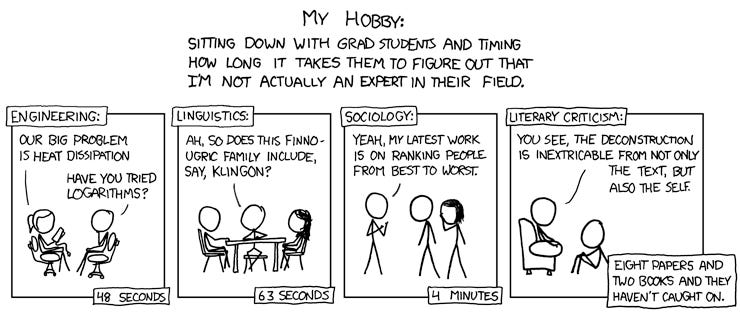
It was an heady time, but of course there were haters. Very vocal haters. The chief criticism aimed at theory was its jargon-filled prose. This XKCD summarizes the sentiment:
That was the scene, 30 years ago today, when something truly wild happened. In the new issue of the esteemed cultural studies journal Social Text, an NYU physics professor named Alan Sokal published a paper titled “Transgressing the Boundaries: Towards a Transformative Hermeneutics of Quantum Gravity.” Yep, as you guessed from the title, it was a hoax.
With slabs of stitched-together academic gibberish, Sokal mocked postmodernism by claiming quantum gravity was politically progressive and physical reality was a linguistic construct. Because it came from a credentialed physicist from a prestigious institution, the parody hit hard and the blast radius went wide. The New York Times put it on the front page and everyone with a substack newspaper column had their say. George Will fastballed in WaPo, Stanley Fish retorted in NYT, and Derrida himself fired back in Le Monde with the most plainspoken copy he’s ever produced. The whole ordeal reportedly made the homepage of People.com.
For me personally, the situation created mixed emotions. As a self-identified theoryhead, it was a sucker punch. I had invested crucial academic time in learning this arcane world, swimming in the aquarium of mysterious terms like aporia, subaltern, and différance. More importantly, I found the worldview and toolset of postmodernism extremely valuable. (Full disclosure: I still do, mostly.) The parody seemed unfair. I had also spent plenty of hours studying calculus and computer science, but no one was vilifying those fields. Why was literary criticism expected to appeal to casuals, while other fields were naturally accepted as too difficult for amateurs? Wasn’t language a real mystery — perhaps our biggest mystery — and wasn’t deconstruction a fresh attempt at uncloaking that mystery?
But on the other hand, Sokal’s parody was fucking hilarious. In my heart of hearts, I’m a hick from the midwest who loathes pretension, and theoryheads could be remarkably pretentious. Plus, I loooove a good hoax, especially a literary one. (My book is stuffed with them.)
Since the heyday of theorymania, the humanities have sadly tumbled out of focus from American discourse. Once a bold new field, Cultural Studies is rudderless. No magazine editor is clamoring to put a philosopher on the cover. If you say you analyze literary texts today, someone might ask if you do reinforcement learning for an LLM.
Actually, reading it today, “Transgressing the Boundaries: Towards a Transformative Hermeneutics of Quantum Gravity” seems less a parody of postmodernism than a hallucination from a chatbot: Total nonsense, weirdly plausible, and utterly delightful.
I miss the postmodernists. They would have loved chatbots.
MORE ANNIVERSARIES
30 Years Ago Today: Barb Wire (1996), starring Pamela Anderson, premiered in movie theaters. It was nominated for a Golden Raspberry, but lost to Striptease.
30 Years Ago Today: I Shot Andy Warhol (1996) made its debut in theaters.
250 Years Ago Today: The Illuminati was founded in Bavaria.